
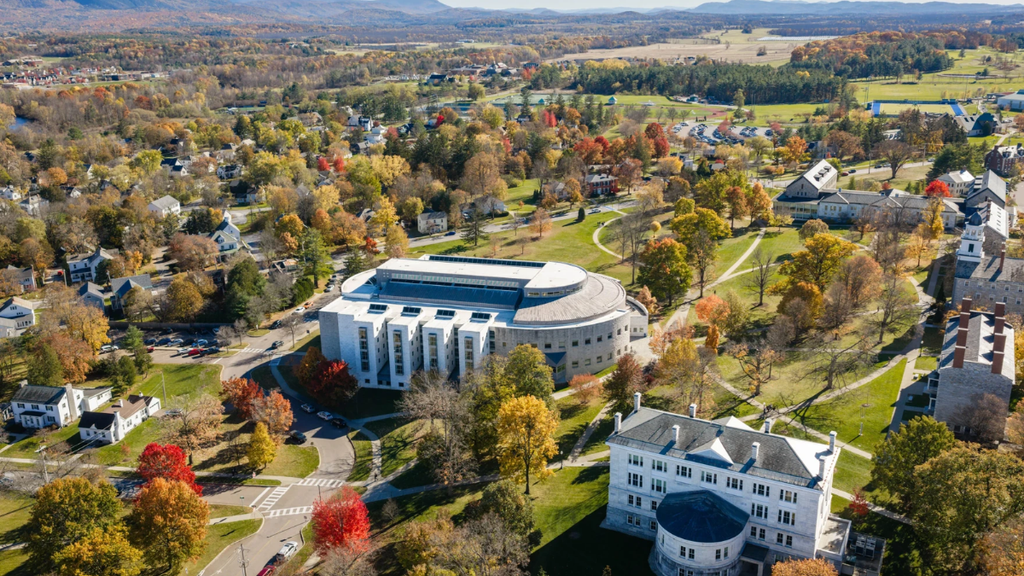
Middlebury College in Vermont looks like a place only the rich can afford. It has old limestone buildings, perfect green lawns and a small-town setting that feels straight out of a holiday movie. But the college is now working hard to tell families something different: it may cost a lot less than you think.
Middlebury’s New Free Tuition Promise
Middlebury has announced that students from families earning $175,000 a year or less can attend tuition-free. The plan starts next year.
That sounds like a big jump in financial aid, because $175,000 is more than twice the median household income in the US. In reality, only a few extra families will benefit. The college says it will help about 35 to 50 more students in an incoming class of around 630. Most students from families under that income level already weren’t paying tuition.
So what’s the real point? Experts say it’s about clearing up confusion. Middlebury president Ian Baucom said the goal is to keep the message simple: if your family earns $175,000 or less, you don’t pay tuition.
The Real Problem: Nobody Knows What College Costs
Figuring out the true price of college has become a major headache for American families.
- Price drives choices: A Sallie Mae survey found that nearly 80% of families crossed a school off their list because of its price.
- Aid feels confusing: Close to 70% of students and parents told the Strada Education Foundation that the financial aid process is partly or completely confusing.
- Families guess wrong: A Gallup and Lumina Foundation survey found that more than three in four adults without degrees couldn’t estimate the price of a public four-year college within $5,000.
Wellesley College economist Phillip Levine says many of these colleges aren’t really cutting prices. They’re just making them clearer. At most schools offering these guarantees, he says, college was already free for almost all of those students.
Why Sticker Prices Are So Misleading
Colleges often advertise a high “list price” and then hand out discounts they call scholarships. At Middlebury, the listed cost of attendance is $97,386 a year.
That gap has grown so large that at 445 colleges, not one student pays the full advertised price, according to a Hechinger Report analysis of federal data. At private nonprofit four-year schools, fewer than one in five families pay it.
The problem is that families usually don’t see their final price until after acceptance and filing the FAFSA. One Wisconsin parent touring Middlebury compared it to medical bills: you don’t know the cost until all the paperwork is done.
One important point: free tuition doesn’t cover everything. Room, board, books and travel still cost $24,462 a year at Middlebury, though other aid may help with those costs.
Other Colleges Making Similar Moves
Middlebury is joining a growing list of schools with income-based tuition promises:
- Princeton: most families earning up to $250,000 (with typical assets)
- University of Chicago: $250,000
- MIT, Harvard and Swarthmore: $200,000
- Davidson: $175,000
- Wake Forest: in-state students from families earning $200,000 or less, starting this fall
- Earlham College: Indiana families earning $100,000 or less
- Marist University: tuition, room and board capped at $32,000 a year for New York families earning $200,000 or less, starting next year
- New Hampshire public colleges: free tuition for first-year students from families earning $100,000 or less
The University of Pennsylvania, already tuition-free for families under $200,000, has also launched a calculator that shows families their likely cost before they even apply. Some schools, like Prescott College, the University of Tulsa and Concordia University, St. Paul, are simply lowering their prices.
Why This Matters Now
Middlebury admissions dean Nicole Curvin says families are anxious about living costs, the job market and even AI. In her words, affordability is “the top question that every family is asking us.”
For Baucom, the issue goes beyond one college. He believes higher education should feel open to every family, not just the wealthy ones looking at those fancy campus photos.